
✓ Server Room & IDF Cleanup
✓Labelling & Documentation
✓Dead Cable Removal
✓ Serving SF Bay Area Since 2009
✓ CA C-7 Licensed & Insured
✓ BICSI Certified Technicians
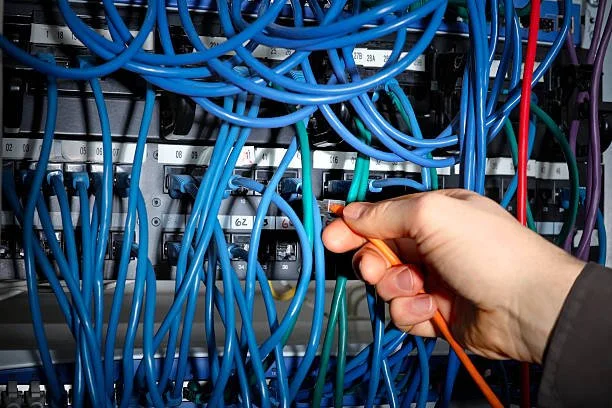
IDF Cleanup Deliverables
- Completed physical cleanup — all decommissioned patch cords and equipment removed
- Active ports verified before any cord removal
- Correct-length patch cords throughout, dressed through cable managers
- Cable managers installed where required
- Rack equipment repositioned to logical groupings with blanking panels
- Before-and-after photo documentation — every rack and panel face
- Updated port count — active port inventory reflecting post-cleanup state
Labelling & Documentation Deliverables
- Brady-printed labels on every cable — both ends, every panel port, every outlet faceplate
- Consistent labelling convention document — so future staff can maintain the system
- Port map spreadsheet: panel port → cable ID → outlet location → device type
- As-built floor plan with every outlet location and cable ID marked
- IDF/MDF schematic: rack layout, panel assignments, switch port map
- Photo documentation of every panel face post-labelling
Dead Cable Removal Deliverables
- Pre-removal identification: active vs dead cable documentation for the scope
- All identified decommissioned cable removed from specified areas
- Conduit runs cleared and pull strings installed where required
- Ceiling tiles and access panels restored to original condition
- Removal record: cable type, approximate quantity, disposal method
- NEC 800.25 compliance declaration for the scope of work
- Photo documentation: ceiling access areas, conduit entries, IDF before/after
Cabling Remediation Deliverables
- Pre-remediation test reports identifying every failing run and failure mode
- Remediation scope: specific action required for each failing run
- Completed remediation work — re-termination, replacement, or pathway correction
- Post-remediation TIA-568.2-D Level IV certification for every remediated run
- Updated documentation set — failing test reports replaced by passing reports
- Summary report: runs remediated, actions taken, post-remediation pass rate
| Failure Found | Likely Cause | Remediation Action | Time Per Run |
| NEXT / PS-NEXT failure | Excessive untwist at keystone or patch panel termination | Re-terminate both ends to correct untwist specification | 20–30 min |
| Return loss failure | Kink or crush point in cable; out-of-spec connector | Locate fault with Fluke; replace cable section or re-route | 1–3 hrs |
| Marginal PoE delivery | Run over 90m or 100m; wrong cable type; damaged cable | Measure actual run length; shorten pathway or replace cable | 2–4 hrs |
| Wiremap — split pair | Incorrect termination — mismatched pairs at one or both ends | Re-terminate to correct TIA-568B wiring at both ends | 15–25 min |
| Delay skew failure | Non-standard cable mixed into run; alien cable at outlet | Identify non-standard cable section; replace with correct category | 1–4 hrs |
| Marginal PoE delivery | High DC resistance — long run, poor contacts, or wrong cable | Re-terminate for contact improvement; replace if run is too long | 30 min–2 hrs |
Cable Management & Remediation Across San Francisco & the Bay Area
Based in San Francisco, serving the entire Bay Area. Free assessment visits citywide and throughout the region.
- Financial District
- SoMa (South of Market)
- Mission District
- Union Square
- Civic Center
- Chinatown
- North Beach
- Embarcadero
- Nob Hill
- Hayes Valley
- Oakland
- Berkeley
- South San Francisco
- San Mateo
- Palo Alto
- Redwood City
- San Jose
- Fremont
- Hayward
- Walnut Creek
Cable Management & Remediation FAQ — San Francisco
How much does an IDF cleanup and labelling project cost in San Francisco?
A single IDF closet cleanup with labelling and port map typically runs $800–$2,500 depending on the number of ports, the severity of the current state, and whether new cable managers need to be installed. A three-floor building with an IDF on each floor typically runs $2,500–$6,000 for the complete cleanup, labelling, and documentation scope.
Server room re-organisation and labelling — larger rack count, more ports, more documentation — typically runs $3,000–$10,000+ depending on the number of racks and the complexity of what’s there. We provide fixed-price quotes after a free on-site assessment, so you know the exact cost before committing to the project.
Can you do the cleanup without disrupting our live network?
Yes — this is how we approach every cleanup project in an occupied San Francisco building. The first step is identifying every active connection before touching anything. We use tone generators to trace unlabelled cables, check link lights on switch ports, and verify PoE device connections. Only confirmed-dead connections are removed without a maintenance window. Active ports that need to be moved, re-labelled at the patch panel end, or re-terminated are scheduled with your IT team for brief maintenance windows — typically early morning before business hours.
We’ve cleaned and organised IDF closets and server rooms in occupied Financial District law firms, SoMa tech company offices, and Mission Bay production facilities — buildings where any unplanned network outage is a serious problem — without causing a single unplanned disruption. The methodical identification step is what makes this possible.
Is abandoned cable in our ceiling a real legal issue in San Francisco?
Yes. NEC 800.25 requires removal of abandoned communications cables from buildings. California has adopted the 2020 National Electrical Code, which includes this provision, and the California Building Standards Commission has incorporated it into the California Electrical Code. Most San Francisco commercial building jurisdictions enforce NEC provisions through the building inspection process.
In practice, enforcement in San Francisco commercial buildings typically happens in two ways: building management companies are increasingly including abandoned cable removal as a requirement in tenant improvement scopes and lease renewals — especially in newer Financial District, SoMa, and Mission Bay tower stock; and fire code inspections can cite excessive cable accumulation in plenum spaces as a fire load violation. We include an NEC 800.25 compliance statement with every dead cable removal project so you have documentation if building management or an inspector asks.
We have no documentation at all for our existing cabling. Where do you start?
From the physical plant — which is the only reliable source of truth in a building with no documentation. We start by physically tracing every cable: tone generator at one end, inductive probe at the other, recording the cable ID, source endpoint (patch panel port), and destination endpoint (outlet location and device type). It’s methodical and time-consuming, but it’s the only way to build documentation you can trust.
A documentation project for a 100-port single-floor office typically takes 1–2 days of physical tracing. A 300-port three-floor building typically takes 3–5 days. Once the physical tracing is complete, we build the port map spreadsheet, create the as-built floor plan with outlet locations, and apply labels to every cable at both ends. The result is a complete, accurate documentation set — regardless of how undocumented the infrastructure was when we arrived.
How do you know which cables are dead and which are live?
We use a combination of methods: a tone generator and inductive probe traces any cable to both its endpoints; network switch port link status (the link LED or switch port statistics) confirms whether a data port is active; PoE power delivery testing confirms whether a PoE device is connected and drawing power; and for analog cables (phone, security, fire alarm) we look for terminations at both ends and, where necessary, test for voltage or signal presence.
We also check with your IT team before starting work — who knows which switches, servers, and devices are running, and often knows that specific areas have decommissioned cabling even if they can’t identify individual cables. The combination of our physical testing and your operational knowledge is what allows us to be confident before removing anything. When we genuinely can’t determine whether a cable is live or dead, we tag it rather than remove it and flag it in the documentation for your IT team to confirm.
After cleanup, how do we maintain the labelling system going forward?
We deliver a labelling convention document as part of every project — a one-page guide explaining the labelling system we’ve implemented, what each label component means, and how to apply labels consistently when adding new ports. We also deliver the port map in an editable spreadsheet format (Excel or Google Sheets) with instructions for updating it as moves, adds, and changes are made.
For organisations that want to maintain the labelling system themselves, we recommend investing in a Brady BMP61 label printer — the same printer we use — and keeping a supply of appropriate labels on hand. For organisations that prefer to have us return periodically to update documentation and address accumulated changes, we offer scheduled maintenance visits. Many of our San Francisco clients schedule a half-day or full-day visit annually to update documentation and address any cable management issues that have accumulated.
How long does a typical cable management project take in San Francisco?
A single IDF closet cleanup with labelling typically takes 1–2 days depending on the number of ports and the severity of the current state. A three-floor building with an IDF per floor typically takes 3–5 days for the complete scope — cleanup, labelling, dead cable removal from the floor, and documentation. Large multi-floor buildings or server rooms requiring both cleanup and cabling remediation with certification testing are scoped individually.
For occupied San Francisco buildings where we need to schedule around business operations — early morning access to specific spaces, maintenance windows for active port work — we build these constraints into the project schedule during the booking process. We can often accommodate tighter timelines for urgent situations (IT staff departing, building management deadline, compliance audit approaching) by scheduling additional technicians or extended working days.
Should we do cable management now or wait until our next office renovation?
The cost of waiting is real and ongoing. Every hour your IT team spends tracing cables that should be labelled, every troubleshooting session that takes an hour instead of ten minutes because the port map is wrong, every change that gets done incorrectly because nobody knew what was what — these costs accumulate. In our experience with San Francisco businesses, the payback period for a properly done cable management and documentation project is typically less than a year in IT time savings alone.
The case for waiting until a renovation is that you avoid re-doing the documentation when new cabling is added. This is a reasonable consideration — but only if the renovation is imminent (less than 6 months away) and the renovation will add significant new cabling. If the renovation is 2–3 years away and your IT team is struggling with undocumented infrastructure today, the operational cost of waiting isn’t justified. We can scope a cleanup that focuses on documentation and labelling of existing infrastructure — work that won’t be undone by a future renovation — and defer the deeper physical remediation until the renovation creates the opportunity.