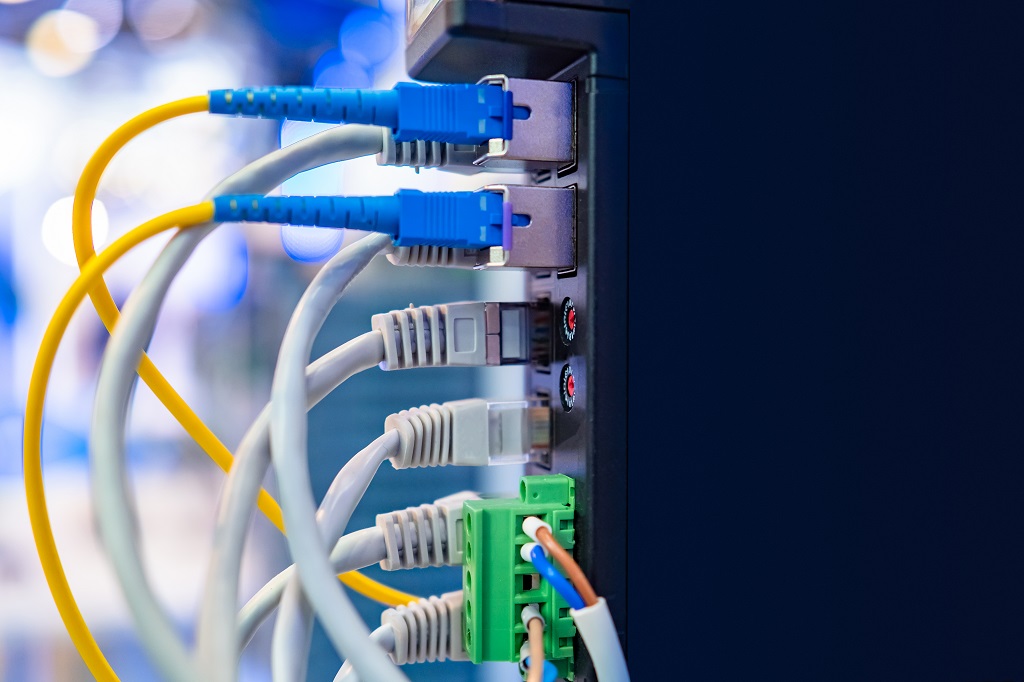
Network Infrastructure Installation in San Francisco
Rack installation, patch panel termination, server room buildouts, and data center cabling for commercial businesses across San Francisco. Every installation designed to ANSI/TIA-569 and TIA-942 standards — organised, documented, and built to last.
Network Infrastructure — The Physical Layer That Everything Runs On
Structured cabling and fiber optic runs are only as good as the infrastructure they terminate into. Racks, enclosures, patch panels, cable pathways, and telecom rooms are the physical layer that determines whether your network is organised, maintainable, and built to scale — or a tangled liability that creates problems for years.
We install complete network infrastructure for commercial businesses across San Francisco — from a single wall-mount rack in a SoMa office to a fully engineered multi-rack server room buildout for a Mission Bay enterprise. Every installation follows ANSI/TIA-569 for pathways and spaces and ANSI/TIA-942 for data center infrastructure.
This page covers our four core network infrastructure services — rack and cabinet installation, patch panel installation, server room cabling buildouts, and data center cabling. We also install the cable tray and pathway systems that support all of them.
Rack & Cabinet Installation
Open-frame racks, enclosed cabinets, and wall-mount enclosures — properly grounded, levelled, and integrated with your cabling and power infrastructure.
Server Room Build-Outs
Complete server room installations: racks, structured cabling, fiber backbone, PDU mounting, cable management, grounding, and as-built drawings.
Patch Panel Installation
Cat6, Cat6A, and fiber patch panels — terminated, tested, labelled to your naming convention, and port-mapped with full documentation.
Data Center Cabling
High-density copper and fiber cabling for colocation and private data centers — top-of-rack, overhead, and under-floor pathways to TIA-942-B standards.
Network Rack & Cabinet Installation — San Francisco
Proper rack and enclosure installation is the foundation of an organised network room. An incorrectly installed rack — not levelled, not grounded, not adequately anchored — creates cable management problems, overheating risks, and safety issues. We do it right the first time.
We install open-frame racks, enclosed cabinets, and wall-mount enclosures for commercial businesses across San Francisco. Whether it’s a single two-post wall mount for a small SoMa office or a 20-rack open-frame deployment for a Mission Bay enterprise, the approach is the same: every rack level, grounded, tied to the building structure, and integrated with your structured cabling and power distribution.
Open-Frame Racks
Two-post and four-post open-frame racks for server rooms and data centers. Maximum airflow access, easy front-to-back cable routing. Available in 19″ and 23″ widths, 24U to 48U heights.
Wall-Mount Enclosures
Shallow-depth and standard-depth wall-mount enclosures for IDF closets, wiring rooms, and small SF office locations where floor space is at a premium.
Enclosed Cabinets
Locking enclosed cabinets for network equipment in shared spaces, offices, and edge locations. Front/rear vented doors, top exhaust options, and castors or levelling feet.
Grounding & Bonding
Every rack properly bonded to building ground per NEC Article 250 and TIA-607. Rack-to-rack bonding jumpers, grounding busbar installation, and telecommunications grounding backbone (TGB) connections.
What’s Included
Delivery and unboxing of rack hardware
Assembly, levelling, and floor anchoring (seismic anchoring available — required in many SF buildings)
PDU mounting and cable routing to power distribution
Integration with patch panels, switches, and cable pathways
Rack labelling and unit position documentation
SF Seismic Compliance
San Francisco is seismically active. Many SF commercial building leases and management requirements mandate seismic bracing for racks and cabinets. We install seismic floor anchoring and four-post seismic bracing kits where required, and can advise on what your specific building requires.
Rack Type
Form Factor
Depth
Typical Use
Two-Post Open Frame
19″ / 23″
Shallow
Patch panels, switches, small IDF closets
Four-Post Open Frame
19″
24″–36″
Servers, UPS, server rooms
Enclosed Cabinet
19″
24″–48″
Shared spaces, edge deployments, offices
Wall-Mount Enclosure
19″
6″–24″
IDF closets, small offices, remote locations
Patch Panel Installation & Termination — San Francisco
Patch panels are the organised termination point where all your structured cabling home runs land in the telecom room. A properly installed, labelled, and documented patch panel makes every move, add, and change in your network take minutes. A poorly terminated or unlabelled panel makes it a hours-long process — or worse, a source of intermittent failures.
We terminate Cat5e, Cat6, Cat6A, and fiber patch panels for San Francisco businesses of all sizes — from a single 24-port panel in a Pacific Heights office to 20+ panels across multiple IDFs in a multi-floor Financial District building. Every port is terminated to TIA-568 standards, tested, labelled to your naming convention, and port-mapped in a spreadsheet delivered at project close.
Cat6 / Cat6A Termination
110-punch termination using Panduit or equivalent tools for consistent, reliable, low-loss connections. All terminations verified with continuity testing. Cat6 and Cat6A panels available in 24, 48, and high-density configurations.
High-Density Panels
Angled patch panels, tool-less patch panels, and high-density solutions (48-port in 1U) for space-constrained SF telecom rooms where rack space is at a premium.
Fiber Patch Panels
LC, SC, and MPO/MTP fiber patch panels for single-mode and multimode fiber termination. Pre-loaded adapter panels, loaded with pigtail-spliced tails, or accepting pre-terminated cable as required.
Cable Dress & Management
All home run cables properly dressed into the panel from the rear, with correct bend radius maintained, strain relief secured, and cables bundled and labelled before they enter the cable management hardware.
What’s Included
Panel rack mounting at correct height relative to switch and cable managers
Home run cable routing from cable management into panel rear
110-punchdown termination (T568B standard, T568A on request)
Level IV continuity test on all ports
TIA-568.2-D performance test if certification is required
Port labelling to your naming convention (or our standard convention)
Complete port map spreadsheet: panel port → cable ID → outlet location
Photo documentation of completed panel
T568A vs T568B — Which Do We Use?
We terminate to T568B by default — the most common commercial wiring standard in the United States. If your organisation uses T568A (common in government installations) or you have existing cabling that must match, simply specify at the time of quote and we terminate accordingly. Mixing T568A and T568B within the same installation creates cross-over links and is a common cause of network problems — we never mix wiring standards within a project.
Panel Type
Density
Height
Common Use
Cat6 24-Port
24 ports
1U
Standard SF office IDF, small rooms
Cat6 48-Port
48 ports
1U
Most common — commercial floor IDFs
Cat6A 24-Port
24 ports
1U–2U
Enterprise, data center, PoE++ environments
Fiber LC 24-Port
12 duplex ports
1U
Fiber backbone termination at MDF/IDF
MPO/MTP Cassette
12–24 fibers/cassette
1U
High-density data center fiber
Server Room Build-Outs — San Francisco
A server room is the most business-critical space in your building. The quality of the cabling, rack layout, power distribution, and cable management determines whether your IT team can work efficiently and whether the room scales cleanly as your business grows — or whether it becomes a disorganised mess in three years.
We design and build complete server room infrastructure for San Francisco businesses — from a single-rack IDF closet in a Castro professional services firm to a dedicated 10-rack server room for a Downtown SF enterprise. Our buildouts cover everything from the cabling entry point to the last patch cord, designed to ANSI/TIA-942 and ANSI/TIA-569 standards.
We’ve built server rooms in occupied office buildings throughout San Francisco, coordinating with building management on fire-rated wall penetrations, ceiling access, conduit routing, and power requirements. We know the permit process, the building management offices at the major Financial District towers, and the practical constraints of building telecom rooms in SF’s diverse commercial building stock.
Room Assessment & Design
We assess your space, evaluate cooling and power, design the rack layout, and produce a cabling design with cable schedule and patch panel port map before installation begins. No improvising on site.
Fiber Backbone
MDF fiber panel installation, inter-rack fiber routing, and fiber patch panel installation. Fusion-spliced connections where required, OTDR tested. Proper bend radius management throughout.
Grounding Infrastructure
TGB (Telecommunications Grounding Busbar) installation, bonding conductor routing, and rack bonding per ANSI/TIA-607-B and NEC Article 800. Essential in older SF buildings with ground noise issues.
Structured Cabling Distribution
All horizontal cabling home runs terminated and dressed at the patch panels. Properly sized cable tray or J-hook pathways from the cabling entry point to every rack. Color-coded cable management where applicable.
Rack & Power Layout
Rack placement with proper hot aisle/cold aisle spacing, PDU installation, and cable management hardware integration. Seismic anchoring per SF building requirements where applicable.
Cable Management & Labelling
Horizontal and vertical cable managers in every rack, all cables properly dressed, velcro-tied, and labelled. Every patch panel port labelled both front and rear, with port map delivered at close.
What’s Delivered at Project Close
As-built drawings: floor plan showing rack positions, cabling entry, and pathway layout
Rack elevation drawings: unit-by-unit layout of equipment and patch panels per rack
Complete port map: patch panel port → cable ID → outlet location (every run)
Cable schedule: every cable labelled with IDs matching the port map
Test reports: Level IV or TIA-568 certification for all copper, OTDR for all fiber
Photo documentation: complete photo set of finished room, every rack, every panel
Manufacturer warranty registration where applicable
Data Center Cabling — San Francisco
Data center cabling is the most precision-intensive cabling environment — high density, zero tolerance for errors, and the requirement that every run be documented, tested, and certified. We install structured cabling and fiber for colocation spaces, private data centers, and enterprise server rooms across San Francisco to ANSI/TIA-942-B standards.
San Francisco has a growing data center market — colocation facilities in SoMa, the Financial District, and the greater Bay Area serve thousands of enterprise tenants. We’ve worked in many of these facilities as a tenant contractor, navigating their change management processes, Meet Me Room (MMR) access procedures, and cabling standards. We understand what “bring your own contractor” means in an SF colo environment.
Top-of-Rack (ToR) Cabling
Cat6A copper and OM4/OS2 fiber home runs from top-of-rack switch positions to distribution frames. Properly managed, labelled, and routed per the facility’s pathway standards and your own documentation requirements.
Under-Floor Cabling
Under-floor copper and fiber routing for facilities with raised-floor infrastructure. Proper sealing of floor cutouts, grommets on all penetrations, and documentation of under-floor pathways in as-built drawings.
Colocation Build-Outs
End-to-end colocation cage and suite build-outs in San Francisco facilities: rack installation, overhead cabling to MMR, structured cabling within the cage, and cross-connect ordering coordination with the facility.
Overhead Cable Management
Ladder rack, wire basket, and cable tray installation in the overhead space. Copper and fiber pathways run in separate trays with proper segregation, bend radius compliance, and weight loading per TIA-569 and facility requirements.
High-Density Fiber
MPO/MTP trunk cable systems, fiber cassette enclosures, and high-density fiber distribution panels for 40G, 100G, and 400G environments. Pre-terminated trunk systems and on-site fusion splicing both available.
Zone Distribution
TIA-942-B compliant zone cabling from Main Distribution Area (MDA) through Horizontal Distribution Area (HDA) to Zone Distribution Areas (ZDA) and Equipment Distribution Areas (EDA) for scalable data center design.
What’s Delivered at Project Close
As-built data center floor plan with rack locations, cable pathways, and distribution frame positions
Cable schedule: every run identified with end-to-end connectivity and label IDs
TIA-568.2-D or Level IV test reports for all copper cabling
OTDR trace reports (bidirectional) for all fiber strands
Overhead pathway as-built drawings (plan and section)
Photo documentation: complete photo set of every pathway, rack, and panel
Facility cross-connect records where applicable
Standard
Scope
Relevance
ANSI/TIA-942-B
Data center infrastructure and tiers
Defines topology, pathway spacing, and tier ratings
ANSI/TIA-568.2-D
Copper cabling performance
Testing standard for all Cat5e/6/6A installations
ANSI/TIA-568.3-D
Fiber optic cabling performance
Testing standard for all OM3/OM4/OS2 installations
ANSI/TIA-569-D
Pathways and spaces
Cable tray sizing, bend radius, and fill ratios
ANSI/TIA-607-B
Grounding and bonding
TGB installation and rack bonding requirements
Cable Tray & Pathway Installation — San Francisco
Cable tray and pathway systems are the organised routes that carry structured cabling from outlets to the telecom room. A well-designed pathway system makes future cable additions simple, keeps cables protected, maintains proper bend radius, and satisfies NEC and TIA-569 fill ratio requirements. An ad-hoc installation using J-hooks nailed into drywall creates problems as soon as you need to add more cables.
We design and install ladder rack, wire basket tray, and conduit systems for server rooms, data centers, and commercial buildings across San Francisco. Whether it’s overhead cable tray in a Dogpatch warehouse, under-floor pathways in a SoMa data center, or a properly sized conduit stub-out system for a Financial District office, we size and install to TIA-569 standards.
Wire mesh cable basket for telecommunications cabling — lighter than ladder rack, easier to route around obstacles, and ideal for horizontal runs in office ceilings and IDF closets where fill ratios are lower.
Steel and aluminium ladder rack for server rooms and data centers. Overhead installation with proper hanger spacing, grounding, and transition fittings at bends and drops. Available in 6″, 12″, 18″, and 24″ widths.
EMT, rigid, and flexible conduit for protected runs — through walls, in concrete, and in outdoor or industrial environments. Properly sized per NEC fill ratios with pull strings installed for future cable additions.
J-hook pathway systems for lighter-duty horizontal cabling runs in suspended ceilings. Properly spaced per TIA-569 (maximum 4–5 foot intervals), never overfilled, and always maintaining cable bend radius.
What’s Included
Pathway design: sizing, routing, fill ratio calculations per TIA-569
Hardware supply and installation
Proper grounding and bonding of metallic pathway systems
Seismic bracing on overhead systems where required in SF
Fire-rated pathway penetrations and firestopping (3M or equivalent)
Pathway labelling and as-built documentation
Why SF Data Cabling
Why San Francisco Businesses Choose Us for Network Infrastructure
Network infrastructure is a long-term investment. The rack that’s installed today will hold equipment for 10 years. The cable tray built now is where every future cable will live. Here’s why SF businesses trust us with this work.
Designed Before It’s Built
We produce rack elevation drawings, cable schedules, and port maps before a single cable is pulled. This means the installation is organised and documented from day one — not reverse-engineered after the fact. Many SF businesses come to us to clean up an infrastructure that was never designed properly.
CA C-7 Licensed & Insured
California’s C-7 Low Voltage Contractor License (#1234567) is required for all commercial network infrastructure work. We’re fully licensed and insured, with the liability coverage and workers’ compensation required to work in SF’s Class A commercial buildings.
BICSI Certified Technicians
Our technicians hold active BICSI credentials — the global standard for ICT installation professionals. BICSI training covers everything from telecom room design to grounding, from cable tray sizing to TIA-942 data center standards.
Seismic-Aware Installations
San Francisco is earthquake country. We install racks with proper seismic anchoring, design overhead cable trays with appropriate seismic bracing, and understand the seismic requirements in SF commercial building leases and occupancy permits.
SF Building Experience
We’ve built server rooms and installed infrastructure in high-rises in the Financial District and SoMa, creative offices in the Mission and Hayes Valley, tech campuses in Mission Bay, and industrial facilities throughout the Dogpatch and Bayview. SF’s commercial building stock is diverse — we know its quirks.
Full Documentation Delivered
At every project close you receive as-built drawings, rack elevation diagrams, complete port maps, test reports, and photo documentation. Your next IT person — whether that’s tomorrow or in five years — will be able to understand exactly what was installed and where.
From site survey to documentation handoff — a consistent, documented process for every SF project regardless of size.
Free Site Survey
We visit your San Francisco location and assess the existing infrastructure, available space, power distribution, cooling, cable pathways, and building-specific constraints. For server room and data center projects we produce a detailed site survey report. For rack and patch panel projects we confirm scope and identify any access requirements.
Design & Fixed-Price Quote
For any project beyond a simple rack installation we produce a design drawing and cable schedule before quoting. Within 24 hours of the site survey you receive a fixed-price quote with the complete scope of work. No hourly rates, no open-ended estimates, no change orders for scope we identified during the survey.
Pathway & Infrastructure Installation
We install cable tray, conduit, rack hardware, and grounding systems before structured cabling work begins. Pathways are sized to TIA-569 fill ratios, seismically braced where required, and documented with photos as we go. Fire-rated penetrations are sealed with listed firestopping systems.
Cabling, Termination & Dress
Structured cabling and fiber runs are pulled through the installed pathways, terminated at patch panels, labelled, and dressed into cable management hardware. All terminations follow TIA-568 wiring standards and are inspected before being dressed and secured. We document as we go — every cable gets its ID at the time of installation.
Testing & Certification
All copper runs are tested with a Fluke DSX-8000 CableAnalyzer to Level IV or TIA-568.2-D certification standards. All fiber is OTDR tested bidirectionally. Every test is recorded and any failures re-terminated and retested until the entire installation passes.
Documentation & Handoff
You receive: as-built drawings, rack elevation diagrams, cable schedule, port map spreadsheet, test reports, and a complete photo documentation set. For data center projects, facility cross-connect records are included. Manufacturer warranty registration is completed where applicable.
Network Infrastructure Installation Across San Francisco
Our crews are SF-based and serve the entire city and greater Bay Area. We know the buildings, the permit offices, and the building management teams in every area we serve.
Financial District
SoMa (South of Market)
Mission District
Union Square
Civic Center
Chinatown
North Beach
Embarcadero
Nob Hill
Hayes Valley
Oakland
Berkeley
South San Francisco
San Mateo
Palo Alto
Redwood City
San Jose
Fremont
Hayward
Walnut Creek
Network Infrastructure FAQ — San Francisco
How much does a server room build-out cost in San Francisco?
Server room build-out costs in San Francisco vary significantly based on scope. A single-rack IDF closet with patch panel and basic cable management typically runs $1,500–$4,000. A 3–5 rack dedicated server room with structured cabling infrastructure, fiber, cable tray, grounding, and full documentation typically runs $8,000–$25,000. A larger 10+ rack server room with complete infrastructure runs $20,000–$60,000+.
The largest variables in SF are: whether the room already exists or needs to be built out from an empty space, power and cooling requirements (which we coordinate but do not supply), building access and permit requirements, and whether seismic anchoring is required. Contact us for a free site survey and fixed-price quote for your specific SF location.