Fiber Optic Cabling
Installation in
San Francisco

What Is Fiber Optic Cabling?

Fiber optic cabling transmits data as pulses of light through ultra-thin glass or plastic strands, rather than electrical signals through copper wire. The result is dramatically higher bandwidth, longer possible distances, complete immunity to electromagnetic interference (EMI), and no signal degradation over long runs — making it the backbone technology of choice for modern commercial networks.

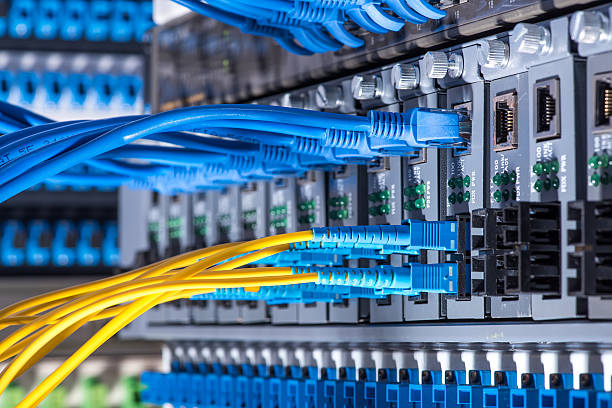
Fiber Optic cables and UTP Network cables connected hub ports.

When Does Your San Francisco Business Need Fiber Over Copper?

Copper structured cabling (Cat6/Cat6A) is the right choice for most office desk drops. Fiber becomes the right choice the moment copper’s limitations appear. Here’s how to think about it.

Fiber Optic — AdvantagesFiber Optic — Considerations
✔ No distance limit for practical commercial runs — OS2 single-mode reaches 10km+
✔ Completely immune to electromagnetic interference — critical in SF’s dense urban buildings, near electrical equipment and elevators
✔ Supports 40G, 100G, 400G — future-proofed for decades of bandwidth growth
✔ No ground loop issues — safe for inter-building connections where copper creates electrical hazards
✔ Thinner, lighter cable — easier to route through conduit and tight spaces in older SF buildings
✔ No data-carrying current — inherently more secure, harder to tap passively
✔ Lower latency at equivalent speeds — matters for trading floors, broadcast, real-time processing
Higher installation cost per run than Cat6 for short distances under 50–60m
Cannot carry PoE power — devices at the endpoint still need a copper drop or local power
Requires specialised splicing and termination equipment and trained technicians
Connectors and patch cords are more sensitive to contamination — requires careful handling
Not required for standard desktop and VoIP drops in typical SF office environments
The SF Rule of Thumb

Use Cat6 or Cat6A for desk drops throughout your office — they’re cost-effective, support PoE for phones and access points, and handle 10G easily. Use fiber for your backbone — the runs between your MDF and IDFs, between floors, between buildings on your campus, and into your data center or server room. This hybrid approach is what we install in the vast majority of SF commercial projects.

Why San Francisco Businesses Choose Us for Fiber Optic Installation

Fiber optic installation demands a higher level of precision, specialised equipment, and certified expertise than copper cabling. Here’s what qualifies our team for your San Francisco project.

BICSI Certified Technicians

California requires a C-7 Low Voltage Contractor License for any commercial structured cabling work. We’re fully licensed and insured — protecting your property and ensuring your install is code-compliant from day one.

Fluke OTDR Certification on Every Strand

Every fiber strand we install is tested with a Fluke OFP-100 OptiFiber Pro OTDR — not just an optical power meter. OTDR traces show insertion loss, reflection events, and fault locations across the full length of every run. You receive the trace files and a signed test report.

Fusion Splice <0.1 dB Loss

Every fiber strand we install is tested with a Fluke OFP-100 OptiFiber Pro OTDR — not just an optical power meter. OTDR traces show insertion loss, reflection events, and fault locations across the full length of every run. You receive the trace files and a signed test report.

CA C-7 Licensed & Insured

California’s C-7 Low Voltage Contractor License is required for commercial fiber optic work. We’re fully licensed, bonded, and insured — and our license number (#1234567) is verifiable at the California CSLB. We handle permit requirements where applicable.

SF Building Experience

We’ve pulled fiber through high-rises in the Financial District, across multi-building tech campuses in SoMa and Mission Bay, through conduit in aging structures in the Tenderloin, and under raised floors in South Bay data centers. SF’s building stock has its quirks — we know them.

Full Documentation Package

We work around your business. Evening, weekend, and phased installs are standard for our SF clients. We’ve run cable in occupied law firms in the Financial District, healthcare clinics in the Civic Center, and live retail spaces in Union Square — without disrupting a day of operations.

Single-Mode vs Multimode Fiber — Which Is Right for Your SF Project?

The two fundamental fiber types serve different distance and speed requirements. Here’s the full breakdown to help you understand which your San Francisco project needs.

TypeCoreMax RangeMax SpeedWavelengthConnector ColorCostBest Use
OM3 Multimode50µm300m (10G)10 Gbps850nm / 1300nmAquaLowerShort intra-building backbone, floor-to-floor
OM4 Multimode50µm550m (10G) / 150m (40G10–40 Gbps850nm / 1300nmErika VioletModerateCampus backbone, data center horizontal, IDF-MDF
OM5 Multimode50µm440m (40G)40–100 Gbps850–950nm (SWDM)Lime GreenHigherHigh-density data centers, 100G+ multimode applications
OS2 Single-Mode9µm10km+ (1G–10G)100 Gbps+1310nm / 1550nmYellowModerate–HighInter-building, campus, WAN, telecom, long-haul

Choose Cat5e if…

Your runs are within a single building or campus, distances are under 550 metres, and you need 10G to 40G throughput. OM4 is the most common fiber type we install in SF commercial buildings — it covers the typical IDF-to-MDF backbone run, floor-to-floor riser, and short campus cross-connections at a cost-effective price point. Active equipment (SFP transceivers) is also more affordable for multimode wavelengths.

Choose Cat6 if…

You need to connect buildings more than 550 metres apart, you’re routing fiber through San Francisco’s underground conduit to connect properties across a block or campus, you need 100G or higher bandwidth today or in the near future, or you’re connecting to a service provider or carrier-grade network. OS2 is also the right choice for any installation where you want maximum future flexibility — the cable cost difference is modest and single-mode fiber is essentially unlimited in bandwidth potential.

Site Survey & Pathway Assessment

We visit your San Francisco location to walk every fiber pathway — underground conduit, risers, plenum spaces, equipment rooms, and building entry points. We identify conduit availability, potential EMI sources, bending radius concerns, and splice point locations. For inter-building work we assess outdoor pathway options including existing underground conduit, aerial options, and trench requirements.

Fiber Design & Strand Count Planning

We design the fiber plant: strand count (always install dark fiber spare capacity — we recommend minimum 2x active strands), fiber type, cable construction (loose-tube, tight-buffered, or armored), splice locations, enclosure placement, and connector types. For campus projects we produce a fiber plant diagram showing every run, splice point, and termination panel.

Fixed-Price Quote

Within 24 hours of the site survey you receive a fixed-price quote covering cable, hardware, installation labour, fusion splicing, connector termination, OTDR testing, and full documentation. No hourly billing, no change orders for scope we identified during the survey.

Cable Installation & Pulling

Fiber cable is installed with strict bend radius management throughout — we never pull fiber through conduit without proper pulling tension control and bend radius protection. Inner-duct is used in shared conduit. Armored cable is specified for any run with crush or rodent risk. Cable is properly secured, supported, and labelled at every transition point.

Fusion Splicing & Termination

Splices are performed using a professional fusion splicer, not hand-polished mechanical splices. Every splice is measured before the closure is sealed — any splice above 0.1 dB is re-done. Connectors are factory-cleaved and polished, inspected under a fiber scope before mating, and cleaned with proper IEC 61300-3-35 compliant tools. MPO/MTP connectors are available for high-density data center applications.

OTDR Testing & Certification

Every fiber strand is tested from both ends using a Fluke OFP-100 OptiFiber Pro OTDR. Bidirectional OTDR testing is required to accurately characterise every event — including splices and connectors — on the fiber link. We test for optical return loss, insertion loss, and check that every event passes ANSI/TIA-568.3-D limits.

Documentation & Handoff

You receive: as-built fiber plant drawings, OTDR trace files (.sor and PDF) for every strand, insertion loss test report, fiber end-to-end connectivity map, splice closure locations, and all warranty documentation. Your network team will have everything needed to manage, troubleshoot, or expand the fiber plant for years to come.

Where Fiber Optic Cabling Is Used Across San Francisco

San Francisco has a uniquely diverse commercial building landscape — from high-rise towers in the Financial District and SoMa to sprawling tech campuses in Mission Bay, biotech facilities in the Mission Bay corridor, and logistics warehouses in the East Bay. Fiber serves a specific role in each.

High-Rise Office Buildings

Floor-to-floor backbone fiber connecting IDFs to the MDF in high-rise buildings throughout the Financial District, SoMa, and the Embarcadero. OM4 for standard floors, OS2 for long risers or any building with active future 100G plans.

Tech Campuses & Headquarters

Multi-building fiber infrastructure for tech company campuses in SoMa, Mission Bay, and the Embarcadero — SF’s tech corridor. OS2 single-mode for inter-building connections, OM4 for within-building backbone and server room connections.

Biotech & Life Sciences

High-bandwidth fiber for biotech and life sciences campuses in Mission Bay and the wider Bay Area. Low-latency fiber networks for research, genomics, and laboratory data systems — where 40G and 100G backbone is increasingly standard.

Data Centers

High-density fiber cabling for colocation and private data centers in the Financial District, SoMa, and throughout the Bay Area. MPO/MTP trunk cables, OM4 top-of-rack connections, and OS2 backbone — installed to TIA-942-B standards.

Healthcare & Medical Campuses

Hospital campus fiber connecting clinical buildings, imaging centers, and administrative facilities across large medical campuses in the SF Bay Area. EMI immunity is critical near MRI and imaging equipment — fiber is the only safe choice in those environments.

University & Education Campuses

Campus-wide fiber networks for colleges and universities across the San Francisco Bay Area — connecting academic buildings, libraries, administration, and residence halls with a high-capacity OS2 fiber backbone feeding OM4 building distribution.

Warehouse & Industrial

Armored fiber for warehouse and logistics facilities in the East Bay, Dogpatch, and the Port area — where long distances, forklift traffic, and industrial EMI make fiber the only practical choice for high-speed connectivity.

Multi-Tenant Office Buildings

Shared fiber riser infrastructure for Class A office buildings throughout the SF Bay Area — providing landlords with the backbone infrastructure to offer high-speed connectivity to all tenants, with individual tenant handoffs at each floor IDF.

Government & Public Safety

Secure fiber networks for City of San Francisco facilities, public safety communications, and county buildings. Fiber’s inherent security advantages — no radiated signal, difficult to tap — make it the preferred choice for sensitive government network infrastructure.

Fiber Optic Installation Across the San Francisco Bay Area

Our fiber crews serve all of the San Francisco Bay Area. We’re familiar with underground conduit infrastructure across SF’s dense urban core, the underground easements between buildings in the Financial District and SoMa, and the campus layouts of the Bay Area’s major institutions.

  • Financial District
  • SoMa (South of Market)
  • Mission District
  • Union Square
  • Civic Center
  • Chinatown
  • North Beach
  • Embarcadero
  • Nob Hill
  • Hayes Valley
  • Oakland
  • Berkeley
  • South San Francisco
  • San Mateo
  • Palo Alto
  • Redwood City
  • San Jose
  • Fremont
  • Hayward
  • Walnut Creek

What San Francisco Businesses Say About Our Fiber Optic Work

★★★★★ 5.0 · 127 Google Reviews — from data centers, tech campuses, healthcare facilities, and corporate offices across the SF Bay Area.

Tom C.

Network Director · Tech Company, Mission Bay

“We needed OS2 single-mode fiber connecting four buildings across our Mission Bay tech campus. Every run was OTDR tested bidirectionally and the results were outstanding — zero margin splices, every strand well under the TIA loss budget. The as-built documentation was the best I’ve seen in 20 years of IT work in the Bay Area.”

Rachel H.

Infrastructure Manager · Data Center, SoMa

“SF Data Cabling installed 48-strand OM4 fiber in our SoMa data center — top-of-rack to patch panels, full MPO trunk system. The installation was immaculate and every strand passed OTDR. They also found and repaired two bad splices from a previous contractor that we didn’t know about. That diagnostic work alone saved us from a future outage.”

Alex W.

Facilities Director · Commercial REIT, Financial District

“We had a mystery fiber issue in our Financial District high-rise that three other contractors couldn’t diagnose. SF Data Cabling found a contaminated LC connector on the 18th floor in under two hours using their OTDR — cleaned it, re-tested, and the link was back to spec. Incredibly efficient and professional. They’re our go-to fiber team for all our SF properties now.”

Lauren K.

IT Manager · Tech Company, Embarcadero

“Our Embarcadero campus expansion required inter-building OS2 fiber through existing conduit with two splices per run. Every splice measured under 0.05 dB — which is exceptional. The team clearly knows what they’re doing with fusion splicing. We’ve since used them for three other SF Bay Area locations.”

Fiber Optic Cabling FAQ — San Francisco

What is the difference between single-mode and multimode fiber?

Single-mode (OS2) fiber has a much smaller core (9µm) that allows only one mode of light to propagate, eliminating modal dispersion and enabling extremely long distances (10km+) and very high bandwidth (100G+). It uses a 1310nm or 1550nm laser source. Single-mode is the right choice for inter-building connections, campus networks, and any run where distance or future bandwidth headroom is a priority.

Multimode (OM3/OM4) fiber has a larger core (50µm) that allows multiple light modes to travel simultaneously. It uses less expensive 850nm VCSEL light sources and supports 10G to 40G over distances up to 550 metres. Multimode is the most common choice for intra-building backbone, floor-to-floor riser, and data center horizontal connections in San Francisco. The active equipment (transceivers) is significantly cheaper for multimode wavelengths, which offsets the cable cost difference for moderate distances.

Can you install fiber optic cable between buildings in San Francisco?

Yes — inter-building fiber is one of our most common projects in SF. The typical approach is to pull fiber through existing underground conduit between buildings if available, or install new conduit through a trench. In some cases, aerial fiber is an option between buildings on a private campus. For connections crossing public streets or sidewalks in San Francisco, encroachment permits from SFMTA or the relevant municipality are required — we handle this process.

We assess the underground conduit infrastructure during the site survey. San Francisco has extensive conduit networks between commercial buildings, particularly in the Financial District, SoMa, and established corporate campuses, but availability varies by location.

Do you repair and troubleshoot existing fiber optic cabling?

Yes. We troubleshoot and repair existing fiber plant throughout San Francisco. Common issues include: broken or cracked fibers (often from construction activity or accidental damage), contaminated connectors (the most common cause of intermittent fiber failures), bad splices from a previous installation, cable cuts during renovation work, and degraded links where bend radius was violated during installation.

Using our OTDR equipment we can locate any fault on a fiber run to within 1 metre, identify contaminated connectors, and characterise any splice or connector that is contributing excessive loss. Most fiber problems in SF commercial buildings are contaminated connectors — which can often be resolved same-day with a proper clean and re-test.

What fiber connector types do you work with?

We work with all standard fiber connector types including LC (the most common in modern enterprise and data center applications), SC (widely used in telecommunications and legacy enterprise), ST (older installations, still found in many SF buildings built in the 1990s–2000s), FC (used in some telecommunications and test equipment), and MPO/MTP (high-density multi-fiber connectors used in data center pre-terminated trunk cables).

We can terminate any of these connector types, install pre-terminated cassettes and trunk cables, and convert between connector types using adapter plates or pigtail splices when required.

How long does a fiber optic installation take in San Francisco?

A single-building backbone installation (IDF to MDF, one or two floors) typically takes 1–2 days including termination, splicing, and OTDR testing. A multi-floor riser installation in a high-rise building typically takes 2–4 days. An inter-building campus installation with underground conduit work can take 3–7 days depending on distance, conduit conditions, and strand count.

Fusion splicing is precise work — we don’t rush it. We schedule realistic timeframes and communicate clearly if anything encountered during the installation (unexpected conduit conditions, building access issues) is going to affect the schedule.

How many fiber strands should I install?

Always install more strands than you need today. The incremental cost of additional fiber strands in a cable is small compared to the cost of pulling a second cable later. Our standard recommendation for a typical SF commercial building backbone is a minimum of 12 strands (6 active, 6 dark spare). For data center connections and high-bandwidth environments we recommend 24 or 48 strands. For inter-building campus runs we recommend 24–96 strands depending on the size of the campus and growth plans.

Dark fiber is cheap insurance. We’ve never had a client in San Francisco say they installed too much fiber — we’ve had many wish they’d installed more when they needed to add capacity.

How much does fiber optic cabling installation cost in San Francisco?

Fiber optic installation in San Francisco typically costs more than copper cabling per run due to the precision termination and testing equipment required, but less per metre than copper for very long runs. A typical single-building backbone installation (4–12 fiber strands, one floor) runs $1,500–$4,000. A campus inter-building connection with underground conduit work, fusion splicing, and OTDR certification typically runs $3,000–$12,000+ depending on distance and strand count

Key factors affecting SF fiber costs include: whether existing conduit is available or new conduit needs to be installed, distance and number of splices required, strand count, fiber type (OM4 vs OS2), and access constraints in the building. We provide fixed-price quotes after a free site survey — no open-ended hourly billing.

What is OTDR testing and why does it matter?

OTDR stands for Optical Time Domain Reflectometer. It’s a fiber optic test instrument that sends a light pulse down the fiber and analyzes the reflections and backscatter to produce a “trace” — essentially an x-ray of the entire fiber run showing every event (splice, connector, bend, fault) and its precise location along the cable length.

OTDR testing is superior to a simple optical power meter test because it identifies where problems are, not just whether a problem exists. It measures insertion loss and reflection at every splice and connector, verifies continuity, and will identify a marginal splice or connector that is currently passing but likely to fail. ANSI/TIA-568.3-D requires OTDR testing for all installed optical fiber cabling. We perform bidirectional OTDR testing on every strand and deliver the trace files (.sor format) along with your test reports.